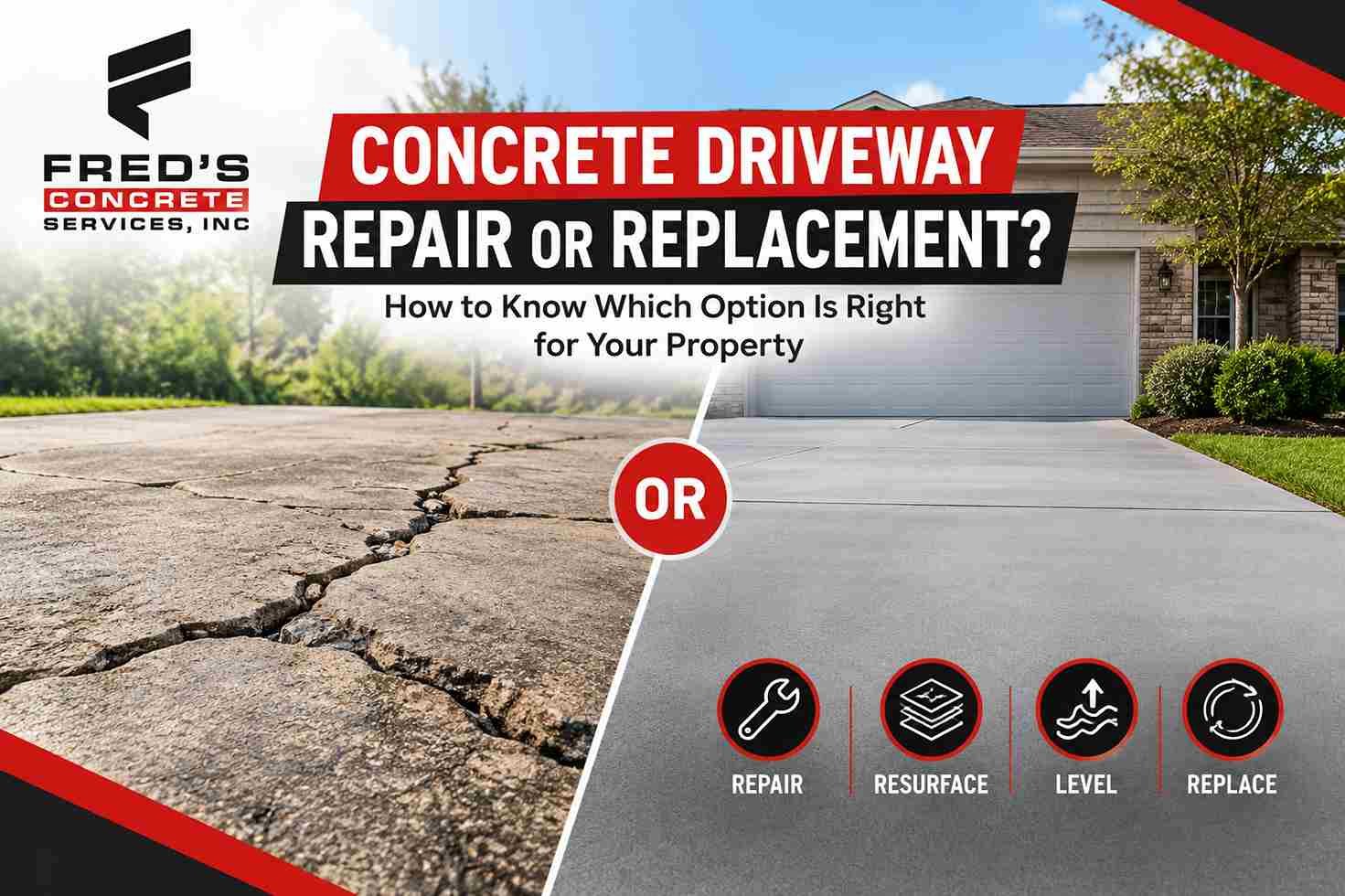
A driveway can show cracks, settlement, discoloration, or surface wear without making the right solution obvious. Choosing concrete driveway repair or replacement should depend on the type, severity, location, and extent of the damage, not simply the driveway’s age.
A stable driveway with isolated problems may need targeted work. Widespread deterioration or structural movement may require replacement. Understanding the difference helps property owners choose an appropriate solution.
Why Choosing Between Driveway Repair and Replacement Matters
Repairing a sound driveway can preserve usable concrete and limit project scope. Replacing a driveway with only isolated damage can create unnecessary expense.
Repeatedly patching a failing slab can also delay a larger problem. The goal is to determine whether the issue is surface level, localized, or connected to the slab and supporting ground.
Common Signs Your Concrete Driveway Needs Repair
Small Surface Cracks
Not every concrete driveway crack signals major failure. Narrow, isolated cracks may be related to normal movement or surface stress.
When the slab remains stable, professional concrete driveway repair may be suitable. The repair should match the type and cause of the cracking rather than simply covering it.
Localized Spalling or Surface Damage
Spalling occurs when portions of the concrete surface chip or flake away. Limited deterioration may be a candidate for spalling concrete repair.
A broader assessment is important because surface damage can sometimes exist alongside deeper deterioration.
Minor Uneven Sections
A small uneven area does not automatically mean the driveway needs replacement. Depending on the slab and cause of movement, concrete leveling services may be appropriate.
Settlement can be related to soil movement, erosion, or drainage, so the underlying condition matters.
Isolated Damage
A damaged corner or small section may be repaired when the rest of the driveway remains sound. Damaged driveway repair can restore an affected area without replacing usable concrete.
When Concrete Driveway Replacement May Be the Better Option
Extensive or Widespread Cracking
A few cracks differ from widespread or interconnected cracking. When deterioration affects large portions of the slab, repeated repairs may become less practical.
Significant cracking can indicate that the concrete or supporting base is no longer performing properly. Concrete driveway replacement may then be the more durable option.
Severe Settling or Major Unevenness
A sinking concrete driveway can create drainage, access, and safety concerns. Major settlement may point to erosion, unstable soil, poor drainage, or other driveway foundation problems.
When substantial sections have shifted, replacement may be more appropriate than repeatedly correcting visible symptoms.
Repeated Repairs Have Not Solved the Problem
If the same areas continue to crack or settle after repair work, the visible damage may not be the root problem.
A detailed driveway damage assessment can help determine whether another repair makes sense or replacement would better address the condition.
Major Structural Deterioration
Severely deteriorated concrete may have too much damage for repair or resurfacing to perform reliably. Widespread failure or major displacement can make replacement more suitable.
Can Concrete Resurfacing Be an Alternative?
Driveway resurfacing may work when the existing concrete remains sufficiently stable but has become worn or unattractive.
It can improve the surface and provide a renewed finish, but it is not suitable for every driveway. Deep structural cracking, severe settlement, or major slab failure may require another solution.
What About Uneven or Sinking Concrete?
Uneven concrete can result from soil settlement, erosion, water movement, or drainage conditions. The visible height difference is only part of the problem.
Professional concrete leveling services may be considered when the slab is suitable for correction. The cause of settlement should also be reviewed to reduce the chance of recurring movement.
Concrete Driveway Repair vs. Replacement: Key Differences
| Factor | Repair | Replacement |
|---|---|---|
| Damage | Localized | Extensive |
| Cost | Generally lower | Generally higher |
| Project Scope | Smaller | More extensive |
| Surface Condition | Mostly sound | Severely deteriorated |
| Structural Problems | Limited | Significant |
| Best For | Isolated issues | Major deterioration |
These are general guidelines, not fixed rules. A driveway with limited visible damage can still have underlying problems, while some worn surfaces may remain candidates for restoration.
Factors That Affect Concrete Driveway Repair or Replacement Costs
There is no single reliable figure for driveway concrete repair cost because every property is different. Important factors include:
- Driveway size and layout
- Severity and extent of cracking
- Concrete thickness
- Base or subgrade condition
- Drainage concerns
- Site accessibility
- Removal and disposal requirements
- Leveling or resurfacing needs
- Residential or commercial use
A site specific evaluation is more useful than generic online pricing because the actual condition of the driveway determines the scope of work.
How to Decide Which Option Is Right for Your Driveway
Repair may make sense when:
- Damage is limited
- The slab remains generally stable
- Problems are mainly surface related
- Most of the driveway remains functional
Replacement may make sense when:
- Damage is widespread
- Settlement is severe
- Structural integrity is compromised
- Previous repairs continue to fail
The right choice should be based on the driveway’s condition and the cause of the damage.
How Professional Concrete Contractors Evaluate Driveway Damage
A qualified concrete repair contractor looks beyond the most visible crack. An assessment may include:
- Inspecting cracks and damaged areas
- Checking settlement and slope
- Evaluating surface deterioration
- Looking for drainage problems
- Reviewing the overall slab condition
- Comparing repair, leveling, resurfacing, and replacement options
This process gives property owners a clearer understanding of what the driveway actually needs instead of relying on appearance alone.
How to Prevent Future Concrete Driveway Problems
Good concrete driveway maintenance focuses on catching problems early and limiting conditions that contribute to deterioration.
Property owners can:
- Address visible damage before it spreads
- Manage drainage around the driveway
- Avoid unnecessary heavy loads
- Monitor joints, cracks, and surface wear
- Seek professional assessment when deterioration becomes noticeable
Early attention can help prevent minor deterioration from becoming a larger project.
Frequently Asked Questions
Is it cheaper to repair or replace a concrete driveway?
Repair is generally less extensive when damage is localized. Replacement can involve removal, preparation, and a new slab. The actual concrete driveway repair or replacement decision depends on property conditions.
Can a badly cracked concrete driveway be repaired?
Some cracked driveways can be repaired, but widespread cracking, settlement, or recurring failures may indicate deeper problems that require replacement.
When should a concrete driveway be resurfaced?
Resurfacing may work when the underlying concrete remains stable but the surface has moderate wear or deterioration. It is less suitable for major structural problems.
Can uneven concrete be leveled instead of replaced?
Sometimes. The slab’s condition, degree of movement, and cause of settlement should be evaluated before choosing leveling.
How do I know if my driveway has structural damage?
Widespread cracks, major settlement, recurring failures, large elevation changes, and severe deterioration can be warning signs. A professional assessment can provide a clearer answer.
Choosing the Right Solution for Your Concrete Driveway
The decision can be viewed as Repair → Resurface → Level → Replace, but that sequence is not a universal rule. Each driveway has different conditions.
Fred’s Concrete Services provides residential and commercial professional concrete services across East Texas, including driveway installation, concrete repairs, resurfacing, leveling, sidewalks, foundations, patios, and parking work.
A professional evaluation can help determine which option fits the property’s condition and long term needs.
Conclusion
A damaged driveway does not automatically require complete replacement. Understanding concrete driveway repair or replacement, resurfacing, and leveling gives property owners a clearer way to evaluate their options.
The best solution is the one that addresses the actual condition of the concrete and its supporting surface. Property owners in East Texas can contact Fred’s Concrete Services for a professional assessment and an appropriate concrete solution.